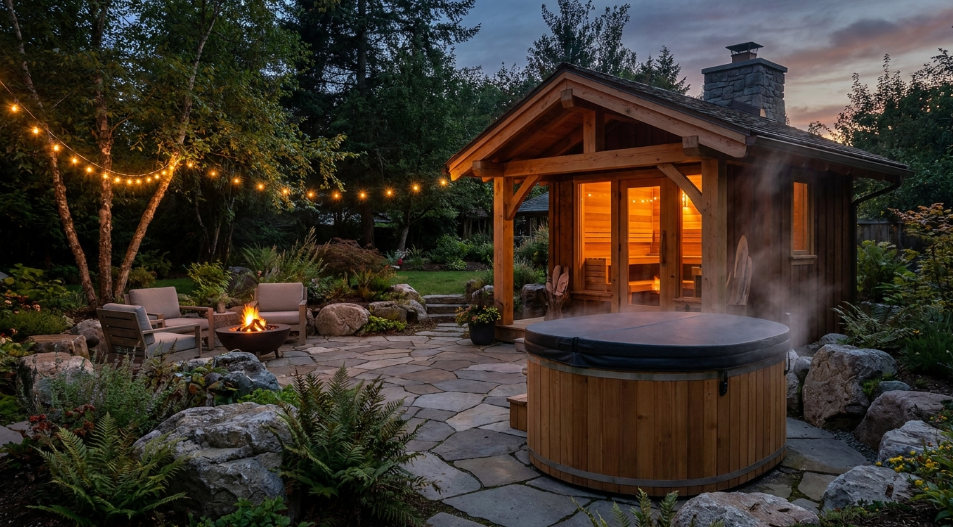
Winter is the easiest season to run a cold plunge because ambient air temperature does much of the chiller’s work for you, cutting electricity use and recovery time between sessions. An outdoor unit in a 30 to 40 degree environment barely has to cycle to hold water at 45 to 55 degrees, compared to constant running against 90-degree summer air. Starting the habit when the cold feels less like a shock against the surrounding temperature also tends to make the routine easier to stick with once warmer months arrive. Here’s how to set up and run a cold plunge through the winter months, and what changes once the temperature drops.
Why Does Winter Make the Chiller’s Job Easier?
A chiller has to remove heat from the water to hold a target temperature, and the amount of work required scales with the gap between that target and the surrounding air. In July, an outdoor tub sitting in 90-degree heat needs a chiller running almost constantly to hold water at 50 degrees. In January, with air already sitting at 35 or 40 degrees, that same chiller might cycle on for a few minutes an hour instead of running nonstop. The practical result is lower electricity bills, less wear on the compressor, and water that holds a stable temperature with far less mechanical effort.
How Should You Set Up a Cold Plunge for Cold-Weather Use?
Start with the plumbing. Any exposed line or pump housing needs either heat tape or a drain-down routine for nights that drop well below freezing, since ice expanding inside a pump or filter housing is one of the more common winter failure points. An insulated cover matters more in winter than summer, both to hold the chilled temperature and to keep snow and debris out between uses. If the unit sits on a deck or patio, clear ice buildup around the entry point regularly. A slick surface next to cold water is a bad combination.
Does Cold Exposure Actually Work Differently in Winter?
Physiologically, the water itself doesn’t know what season it is, and the target temperature range most owners use, roughly 45 to 55 degrees, stays the same year-round. What changes is everything around the plunge: how the body handles the transition afterward in cold outdoor air, how much longer it takes to warm back up without direct sun, and how much more deliberate a person tends to be about breathing and pacing when the whole environment already feels cold. A 2018 study in the American Journal of Physiology on the combined effects of heat and cold exposure, focused on Finnish sauna practices, found the body’s cold-response mechanisms are broadly consistent regardless of ambient conditions, which supports treating the water temperature, not the season, as the main variable that matters physiologically.
How Do You Warm Back Up Safely After a Winter Session?
Getting dry and into warm layers fast matters more in winter than any other season, since wet skin loses heat quickly in cold outdoor air even after the plunge itself is over. Keep a robe or heavy towel within arm’s reach of the tub rather than inside the house, and have warm, dry clothes staged nearby instead of a walk through a cold hallway first. Some owners pair a winter cold plunge with a nearby sauna or hot shower specifically for this reason, since moving straight from cold water into a heat source shortens the uncomfortable window before the body’s core temperature recovers.
Is There Evidence Behind Pairing Cold Exposure With a Winter Wellness Routine?
A 2023 review in Mayo Clinic Proceedings looking at whether combining sauna bathing with other lifestyle habits confers additional health benefits found that stacking heat exposure with other consistent wellness habits, like regular activity and good sleep, showed a more favorable pattern than any single habit alone, though the researchers were careful to frame this as an association drawn from cohort data rather than a proven causal chain. Cold exposure research specifically is thinner. A 2025 systematic review and meta-analysis in PLoS One found modest, mixed evidence for cold water immersion’s wellbeing benefits, which is worth keeping in mind rather than assuming winter cold plunging delivers dramatically more than the water temperature itself provides.
Does Cold Weather Change Filtration and Water Care?
Ozone generators and mechanical filters both keep working in cold temperatures, but a few things shift. Cold water holds dissolved gases differently than warmer water, which can occasionally throw off pH readings on test strips, so check calibration against a fresh strip if a winter reading looks unusual compared to what the same tub showed in warmer months. A pump housing exposed to sub-freezing air for extended periods works harder to keep water moving, which is another reason insulation and, in serious cold, a small in-line heater to prevent the plumbing itself from freezing solid are worth the modest added cost for anyone running a tub through a real winter rather than a mild one.
What Should You Budget for a Winter Setup?
An outdoor chiller-equipped tub built to handle freezing conditions typically costs $3,500 to $7,500, somewhat more than a fair-weather-only model because of the added insulation and freeze protection. Expect lower monthly electricity costs in winter, often $10 to $25 versus $30 to $50 in peak summer heat, which partly offsets the higher initial price over a full year of ownership. Anyone shopping specifically for a cold-weather-rated unit should confirm the manufacturer’s stated minimum operating temperature before buying, since not every model on the market is built to sit outside through a hard freeze. A look at sweatdecks.com shows a few configurations built with colder climates in mind, worth comparing before settling on a size.
Frequently Asked Questions
Is it harder to keep a cold plunge cold in summer than winter?
Yes. The chiller works against a bigger gap between air and water temperature in summer, meaning more run time and higher electricity use.
Can you leave a cold plunge outside all winter?
Most hard-shell units can stay outside if plumbing is drained or heat-taped. Check the manufacturer’s cold-weather guidance first.
Does starting a cold plunge habit in winter make it easier to stick with?
Many owners find it easier since ambient cold already primes the body. There’s no controlled research proving this directly.
Do you need less electricity to run a cold plunge in winter?
Usually yes for outdoor setups, since the chiller cycles less when surrounding air is already close to the target temperature.
Is cold plunging in winter riskier than in warmer months?
The water temperature target stays the same. Added risk comes more from icy surroundings than from the plunge itself.
References
- “Effects of heat and cold on health, with special reference to Finnish sauna bathing.” American Journal of Physiology – Regulatory, Integrative and Comparative Physiology, 2018. https://pubmed.ncbi.nlm.nih.gov/29351426/
- “Does the Combination of Finnish Sauna Bathing and Other Lifestyle Factors Confer Additional Health Benefits? A Review of the Evidence.” Mayo Clinic Proceedings, 2023. https://pubmed.ncbi.nlm.nih.gov/37270272/
- “Effects of cold-water immersion on health and wellbeing: A systematic review and meta-analysis.” PLoS One, 2025. https://pubmed.ncbi.nlm.nih.gov/39879231/
- “Passive Heating: Reviewing Practical Heat Acclimation Strategies for Endurance Athletes.” Frontiers in Physiology, 2018. https://pubmed.ncbi.nlm.nih.gov/30618849/